
A fireside chat with Aytza founder and CEO, Sari Kaganoff
Over the course of her healthcare consulting career, Aytza founder Sari Kaganoff kept seeing health tech founders and innovators plateau or fail at key inflection points in their company’s journey. This pattern was often because these leaders were missing the structured support that enterprise CEO’s have at their disposal. Traditional, high-value consulting isn’t built to meet the unique needs or budgets of fast paced startups, and yet structured guidance at specific moments in the startup lifecycle is critical. The right input at the right moment can help a business find a sustainable path forward and new trajectories of growth.
The advent of large scale LLMs has changed the game for health tech, and for the promise of healthcare innovation overall. For the first time ever, deep strategy consulting can be reimagined with AI, alongside experienced consultants, performing much of the heavy lifting that used to require a full team of analysts. Instead of months-long timelines, insights can now be delivered in days and at a price point that makes sense for startups and growth-stage companies.
Sari sat down for a fireside chat with A-Squared Ventures Partner Sam Cronin at the MIXiii Health-Tech.IL Conference in late June 2026. They spoke candidly about why she chose to jump into the founder seat herself and why this is the moment to build Aytza.
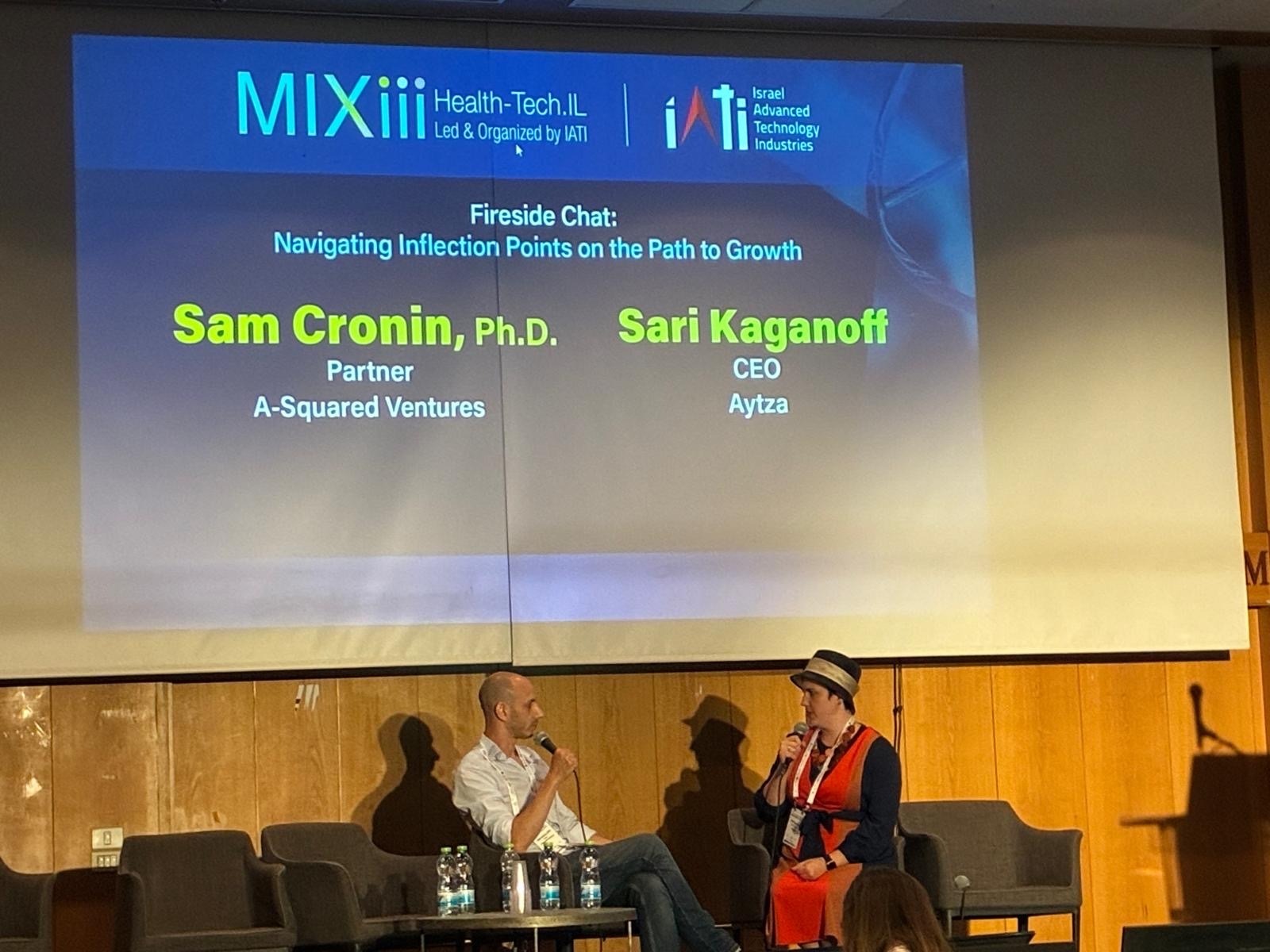
Sam Cronin: Why build Aytza? What does it offer?
Sari Kaganoff: I spent five years at Rock Health building their consulting practice and also was an advisor on their venture fund. Prior to that, I spent seven years at McKinsey & Company, where I co-led the firm’s patient experience domain and health tech work. Aytza grew directly out of those diverse experiences. I kept seeing startup after startup hit an inflection point and plateau or become unsustainable because their leadership lacked the right support system to help them make high impact, time-sensitive decisions.
Before Aytza, there weren't good options to access this type of structured support for startups. Independent advisors tend to offer advice based on their career experience, they don’t do the grunt work. Fractional executives are typically more execution oriented. Aytza is designed to close this gap in mission-critical support and by building a new category: an AI-native consultancy that guides companies through strategic inflection points at the speed, actionability and price point the startup environment demands.
"I kept seeing startup after startup hit an inflection point and plateau or fail because they lacked the right support system to help them make high impact, time-sensitive decisions."
Sam Cronin: Everyone’s talking about how AI is destroying the consulting business. You've chosen to lean into it, and with a specifically tough customer segment. What are you seeing that others aren’t?
Sar Kaganoff: AI is this giant wave. You can ride the wave or get crushed by it.it. Aytza is built to ride that wave, harnessing AI to tackle business challenges from first principles. We’ve broken down the strategy consulting approach to distinct steps that we have AI agents execute, with a human in the loop to guide them. Unlike traditional consulting, Aytza’s system is built from scratch to pair human expertise with traceable, robust data and the power of AI. Startups can't afford a million dollar McKinsey engagement, and even if they could, it’s not designed for the reality of the business environment they operate in. We saw an opening to harness AI to build something custom made for the startup ecosystem. We’ve created the approach and frameworks, as well as the core building blocks, like little LEGO bricks, along with building out proprietary datasets that are uniquely helpful to our clients.
"Aytza’s system is built from scratch to pair human expertise with traceable, robust data and AI."
Sam Cronin: The incumbent consulting business model is built on billable hours, like healthcare’s fee for service versus value based care model. You're trying to create structural changes. Can you explain?
Sari Kaganoff: We’re completely rethinking the consulting model from the ground up to determine what clients should be paying for the value we provide, and how we can deliver at that price. We don’t bill by time because time isn’t a useful measure of value. We primarily price based on fixed fees, and have also offered some clients outcomes-based arrangements. If a project costs us more to deliver today, that's okay because we are investing in the technology and delivery capabilities to be able to deliver that work at the right price tomorrow.
Here’s an example. We recently ran a full market entry and regulatory analysis across four geographies for a client in one week, to help them decide which market to run their trial and commercialize in. We did this by linking clinical trials data to regulatory submissions to map exactly how long it took each competitor to get their clearance, as well as building a market opportunity sizing and competitor analysis to identify white space. We were able to quickly provide data-driven, clear guidance to the client who could then present a data-backed rationale to their board and move forward with confidence rather than making a decision under pressure more aligned with gut than facts.
Sam Cronin: Historically, founders don’t think about getting support from consultants, for the reasons you’ve just shared. What kinds of differentiated help are you offering and how are you helping these startups understand its relevance to them?
Sari Kaganoff: Most founders don't have the expertise, data, and frameworks to run the kind of complex analyses we do, let alone the time to do it. They often come to us with options. They know they can enter four markets, for example, but they're stuck in an echo chamber of pros and cons and maybes. We help refocus the conversation by clarifying the specific questions we need to answer to guide structured decision-making. Questions like: What is the framework that will get you there? What data do we need to fill in that framework? What can be left unknown that won’t hinder action? Then we gather that data, analyze it, and put the results in front of them. Now the founder can make a decision with confidence and importantly, defend the rationale to their board. Our focus is on providing clients robust, traceable data structured to enable them to feel confident in their decision-making.
"Now the founder can make a decision with confidence and importantly, defend the rationale to their board."
Sam Cronin: I know you're relatively early in this journey still, but what has been your biggest moment of impact with a client where you have either held them back from making what would have been a big mistake or helped them figure out the right decision for the company?
Sari Kaganoff: We’re especially proud of our work with Baymatob, an Australian client building an AI enabled medical device that predicts postpartum hemorrhage. We built a full go to market strategy for them, including customer segmentation, competitor analysis, pricing, and partnership strategy. One interesting thing we uncovered as part of the research and customer interviews we were conducting, was that one of their smaller product features was more exciting to the market than their primary product. That insight completely reframed their GTM and fundraising plan because the market they're now tapping into is much bigger and is responding much more enthusiastically than it had to their prior framing.
Sam Cronin: You host a podcast called CEO Pajama Time. What do people tell you privately that they won’t say when recording?
Sari Kaganoff: The premise of CEO Pajama time is that nights and weekends are when CEOs finally have time and space to think about the bigger strategic questions. As we’ve talked about, these CEOs often don’t have guidance to help them think through these critical company defining questions. I wanted to provide a resource for them (and other folks in the startup ecosystem) to understand the behind the scenes journey of other companies. On the podcast I interview CEOs, usually those further along in their journey, about how they handled their strategic inflection points. I’ve gotten to interview some remarkable CEOs, so if you haven’t listened in, you should.
Unsurprisingly, some of the most candid moments come when we stop recording. For example one CEO shared feeling pushed by their board to sell their company when they still believed they could continue to grow it. Our aim is for Aytza to be a resource, helping companies grow strong enough that they never end up in that position.
Aytza is built for leaders who are building the future of healthcare and will continue to evolve to meet their needs. As markets, technology, and policies change, Aytza will be there adapting alongside it to support innovation and growth. Using a combination of expert advisors, proprietary data, and purpose-built AI, Aytza provides the data-driven, actionable, and affordable guidance companies need to move forward with confidence.
Distilled from a live fireside chat between Sari Kaganoff, Aytza CEO, and Sam Cronin, Partner at A-squared Ventures, which took place at the Mixiii Health Tech conference on July 29, 2026.