
What It Takes to Make a Confident Decision
We’re living in a plot twist: it’s an era of abundant information (or slop); but somehow, rather than making it easier, that abundance has made it increasingly more difficult to make a good decision quickly and confidently. We’re left wondering if we can trust the information in front of us, spot checking random facts and swirling in more analysis paralysis.
This has made me think about what a good decision is and how do you make it with confidence? I put these thoughts into an equation I’m calling The Decision Equation (borrowing the equation idea from the Trust Equation concept.)
The Decision Equation works like this:
To make a good decision, you need the right context, data, analysis, and interpretation, and enough confidence in each of those elements to act with conviction. Each of the components is critical to good decision-making, but if you aren’t confident in the robustness of each of those steps, you will undermine yourself and enter analysis paralysis again.
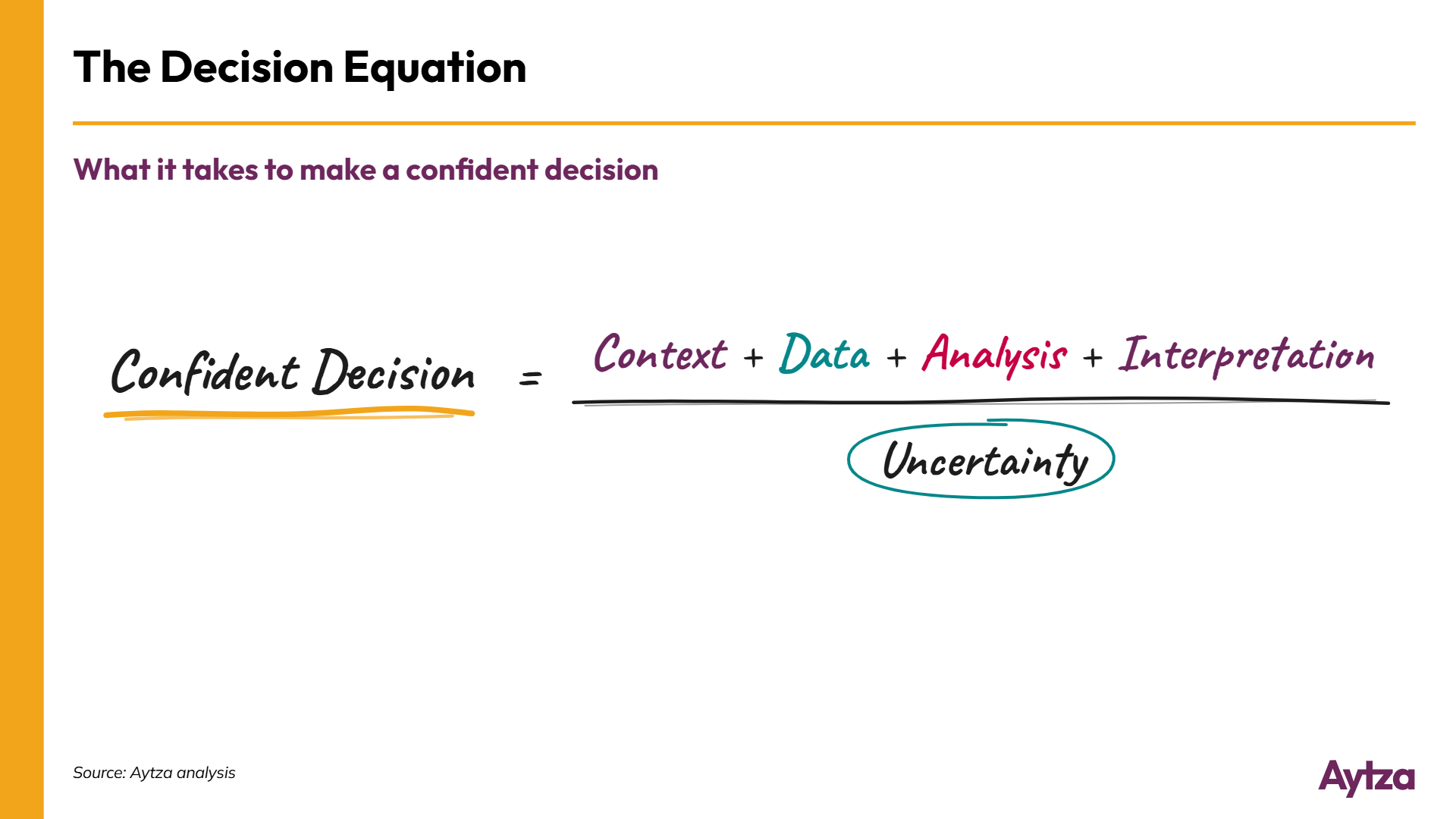
I’ll walk you through each of the components, which build upon each other, and what it means.
1. Context: What decision are you making?
Context starts with understanding the decision you're trying to make and the environment your business operates in. What are your objectives, priorities, and constraints? What's happening in your organization and the broader market? The decision you are trying to make is not a generic decision; it’s a decision for your company, so everything hinges on ensuring you have the context right.
2. Data: What information do you need?
Good decisions are built on good data. Which data will help you make this decision well? What data sounds interesting, but will not actually impact your decision so you shouldn’t even collect or consider it? The context and the decision you are trying to make will determine the data you need. That data needs to be tailored to the context and the specific question you're trying to answer. Maybe there is no robust or reliable data because the market is moving too quickly. Is there anecdata you can use instead (Anecdata being anecdotes strung into enough proof points to be useful as data.) Can you collect or build the dataset you need? Is a tiny triangle of data enough? (See this article I wrote on this topic.) As you are gathering data sources, make sure you understand the context of that data and how it matches to yours, for example, if you find a market report, are they defining the market in the same way you are? (pro tip: usually not.)
It's not just about having enough data. You need the right data, and it needs to be accurate and reliable. Reliability doesn’t necessarily mean that it’s peer reviewed journal articles.it can be a person’s opinion on Reddit, but you do need to know where it came from, when it was refreshed and what level of validity it carries.
3. Analysis: What does the data tell you?
Once you have the data, you need to analyze it to understand what it means. This involves identifying patterns, understanding relationships, and determining what the numbers are telling you. With AI, analysis has gotten much easier, but even with AI you need to think carefully about what cut of the data will help you gain clarity. What time horizon is important? Which fields should you shortlist? What does good look like in terms of the metrics you are seeing when you run the analysis, what’s your baseline, what’s your aspiration? For example, if we’re running a What Must Be True (WMBT) analysis at Aytza to assess what conditions need to be in place for a scenario to play out, we carefully select metrics that will truly impact the situation and that we can measure over time as things change and create a baseline of where things are today.
4. Interpretation: What does the analysis mean for your business?
You think you’re done, you’ve got the context, the data, the analysis, but no, you can't stop there. You need to interpret the findings in the context of your organization and the decision you're making. The same analysis can mean different things for different businesses. Interpretation is about understanding what those findings mean for your specific circumstances. Go back to the context, compare the analysis to the decision you are making and your context, try to interpret what this means for your business. What questions does it raise that you need to answer? What does this mean for your competitors? What might they do?
The Denominator: Uncertainty
The validity of your decision and all the components we just discussed all depends on how confident you are in each of those components. If you're not sure that you got the context right, whether you collected the right data, whether that data is accurate, or whether your analysis and interpretation are sound, you won't have confidence in the decision. You’ll start to waffle, spin, collect more data, ask Claude and GPT a few more times, but you'll struggle to act on it.
This is particularly important with AI. It's increasingly easy to generate data, analysis, and conclusions, but how do you know whether the underlying information is reliable, the analysis is correct, or the interpretation makes sense? If you're working with inaccurate information or AI slop, the entire decision is undermined.
Without that confidence, you risk second-guessing the decision, delaying it, or never actually acting on it.
Author: Sari Kaganoff, CEO, Aytza