Learn How to Beat the Odds From Four Health Tech Operators
It’s hard to get M&A right: finding the right fit, creating value for the acquirer, and creating a good exit for founders. To learn from those who have done it successfully before, Aytza CEO Sari Kaganoff moderated a discussion at HLTH Europe 2026 in June, The Exit Factor: Why M&A is on the Rise in Health Tech.
Sari sat down with four panelists who each bring a different perspective and experience to health tech M&A: Dan Vahdat, CEO and founder of healthcare intelligence and operating system, Huma (which acquired 5 companies); Georgie Smithwick, Managing Director of Techstars Europe (who has been on both sides of M&A transactions as a founder-turned-investor), Lena Lindlar, Partner at healthcare-focused investment bank Blue Tree Group (who oversaw 40 acquisitions during her time at Philips); and Tryggvi Thorgeirsson, CEO and co-founder of digital therapeutics company Sidekick Health (which acquired two companies).
The conversation dug into the practical challenges and best practices for M&A. Here’s a quick checklist to keep in mind depending on which side of the M&A table you sit:
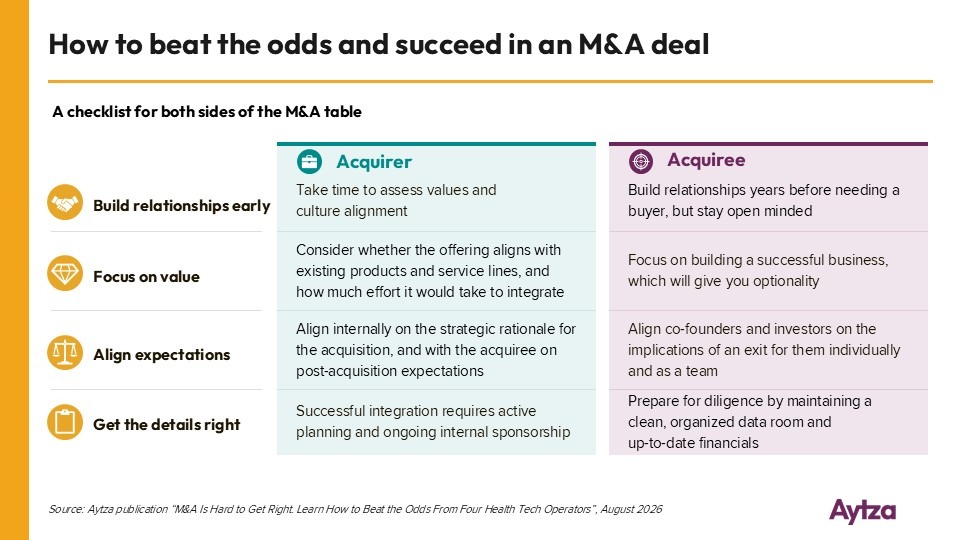
Digging a bit deeper, here’s what each stakeholder should consider during the M&A process:
For the Acquirer
Align on strategic rationale
Acquirers should have a clear understanding of why they are buying that particular asset and how it will support their growth:
- Define your why for the M&A. What strategic purpose does the deal serve? This can be market access, scale, technology, customers, or another capability
- If you just want one asset, acquire it, not the whole company
- For enterprise acquirers, favor targets that are closely aligned with existing products or business lines that can integrate relatively easily into existing operations and infrastructure
“Our first acquisition was primarily about market access. We wanted entry into a specific digital therapeutics market and acquired a company that already had regulatory approval and commercial traction. Our second acquisition was more about scaling…Each acquisition served a different strategic purpose.” Tryggvi Thorgeirsson, CEO, Sidekick Health
Take time to assess cultural fit
Assessing cultural fit is critical to a successful deal:
- Build relationships with potential acquisition targets well before a transaction. In addition to positioning you to find relevant opportunities, knowing that team can help assess cultural fit.
- Spend sufficient time upfront understanding goals, values, and culture alignment rather than optimizing for speed
“Integrating cultures remains one of the hardest parts of M&A” Dan Vahdat, CEO, Huma.
Set clear expectations before signing
Align on what the joint entity will look like and how it will operate before you close:
- Be explicit about why the acquisition is happening and what will and won’t change after it's completed. For example, be clear about plans to discontinue the brand name, fold the entity into yours, replatform the technology, etc.
- Define roles, responsibilities, and decision-making structures for the team members joining your organization, especially for the acquiree leadership
- Expect that diligence will not uncover every issue and that surprises will emerge after closing
“Founders often see the company as their baby. Once it's acquired, tensions can emerge if expectations weren't clearly established beforehand.” Dan Vahdat, CEO, Huma
Set yourself up for integration success
The reality is that most deals fail after closing because integration doesn’t go well or the expected synergies don’t materialize. To protect against that:
- Determine how the acquired company will fit into the existing business, tech stack, products and operating model
- Where customer-base expansion is part of the thesis, have a clear plan for cross-selling and upselling
- Treat cultural integration as a major part of the work
- Recognize that integrations can take years even when the transaction itself closes within months
- Devote sufficient leadership attention and resources, with a clear sponsor and accountability, to actively manage the integration
“The more a company can plug directly into existing infrastructure, the more likely the value creation actually materializes.” Lena Lindlar, Partner, Blue Tree Group
For the Acquiree
Build a strong business to create optionality
Profitability gives the business negotiating power and optionality to exit on their own terms and timeline:
- Focus on building a great product and team, rather than building for exit
- Build toward profitability where possible and demonstrated business performance, since acquirers value evidence of performance more than future potential alone
- A successful monetary outcome for the founder is not always assured; it depends on the terms of the deal and the degree of founder dilution
“Getting to a great monetary outcome requires founders to actively focus on maintaining control, options, and financial sustainability throughout the life of the company.” Georgie Smithwick, Managing Director, Techstars Europe
Build relationships before you need a buyer
Acquisition opportunities can come up suddenly and are often born from existing partnerships or ecosystem connections:
- Identify likely acquirers early and start building those relationships
- Understand the specific problem a potential buyer is trying to solve and how they make decisions
- Frame your value around that buyer problem rather than approaching the process like a fundraising pitch
“Deals take time. What I would recommend to every founder is to start thinking about who could be a potential fit from the beginning and then over time slowly build those relationships. Keep an open mind;. It doesn't help if you have one company that you think is a perfect partner; they might have a different agenda.” Lena Lindlar, Partner, Blue Tree Group
Be clear-eyed on valuation and diligence
Market dynamics, acquirer expectations, and the state of your financials can drastically impact valuations:
- Understand current market realities rather than anchoring to historic valuations
- Learn how the buyer thinks about value.
- Maintain a clean, organized data room, and be aware that poor preparation during diligence can materially reduce valuation
- Manage dilution and founder ownership carefully
“It's understanding the market and understanding that it changes with interest rates and all these external dynamics that you cannot control as a founder, sometimes the market is saturated.” Tryggvi Thorgeirsson, CEO, Sidekick Health
Align expectations all around
Each stakeholder has a different vision of what to expect from a deal. Make sure you get those expectations on the table, so you can all align on what a good outcome looks like:
- Align co-founders and investors on exit expectations early
- Think carefully about what you personally want your role and future to look like after an acquisition, and discuss that with the acquirers
- Recognize that you will be giving up control of the company you built; you will not be CEO in the new setup
“You want to make sure your investors are behind you and aligned on what a good exit looks like. Also, if there are key employees that are important for the acquirier to come over, make sure those people are included in the conversations.” Georgie Smithwick, Managing Director, Techstars Europe
The bottom line: all panelists agreed that there will be much more digital health M&A ahead, not less. The founders who come out ahead will be those who spent years building genuinely strong businesses and real relationships with those most likely to be a fit for them.
For more on how to position your company for a strong exit, read Aytza’s analysis of nearly 500 global M&A deals: Bought not sold: positioning your company for exit optionality.
Author: Sari Kaganoff, CEO, Aytza
Distilled from a live panel conversation moderated by Sari Kaganoff at HLTH Europe 2026. Quotes lightly edited for clarity.
.png)
.png)